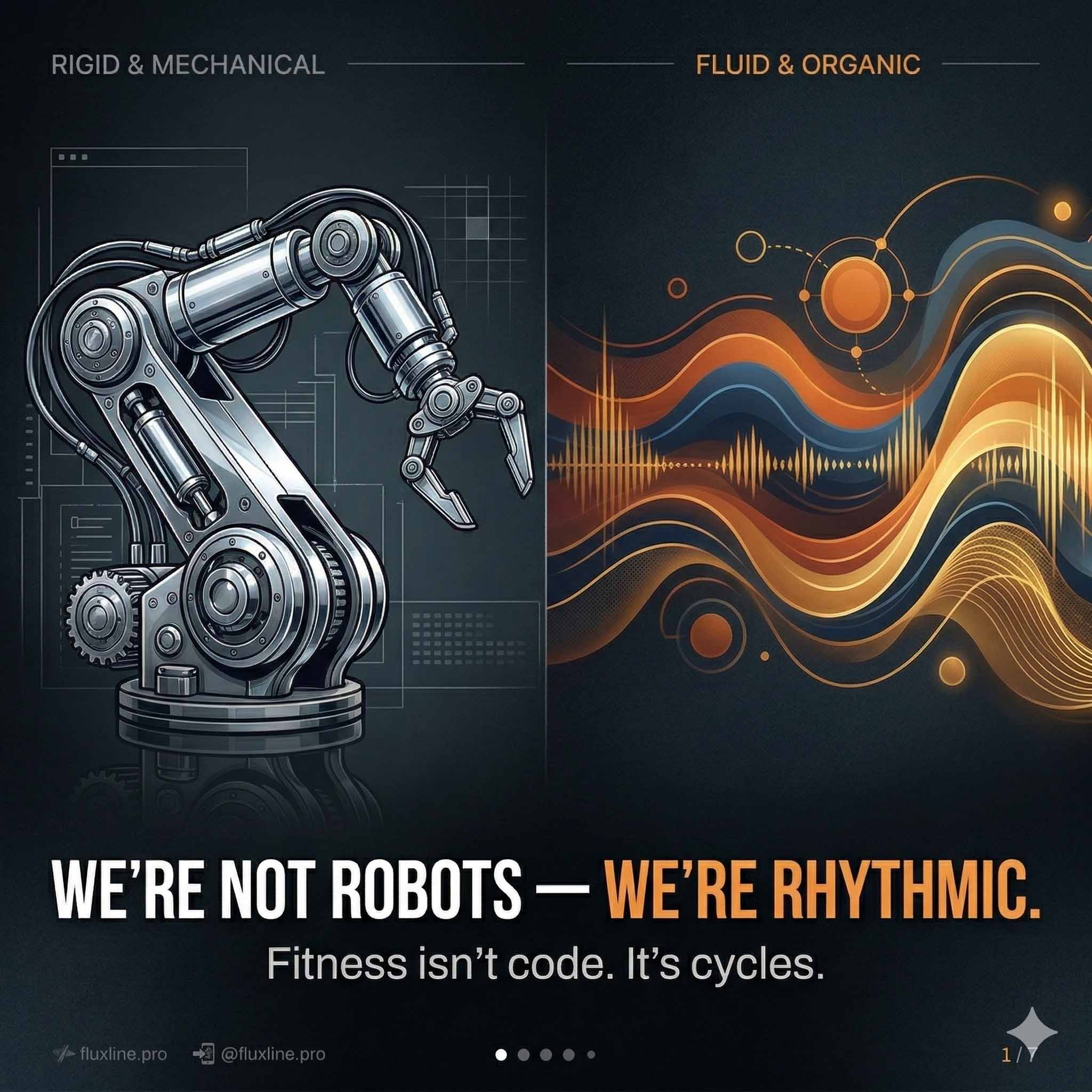
We're Not Robots — We're Rhythmic
Why sustainable fitness is not about perfection, but about pattern.
We're Not Robots — We're Rhythmic
Why sustainable fitness isn't about perfection, but about pattern.
Most people think fitness is about discipline.
About sticking to a rigid plan.
About showing up at the exact same time, doing the exact same workout, hitting the exact same numbers, week after week.
But here's the truth I've learned — in my own training, in my clients, and in the way human bodies actually work:
We're not robots. We're rhythmic.
We don't operate on code.
We operate on cycles — energy waves, circadian cues, emotional states, and readiness signals.
And when you build your fitness around that, everything changes.
1. Consistency beats rigidity
You don't need a perfect routine.
You need a consistent rhythm.
If you train 4–5 days a week, eat enough to support your goals, and keep showing up, you will grow.
You will get stronger.
You will build muscle.
Not because you followed a flawless plan, but because you honored the pattern.
Consistency builds identity.
Rigidity builds burnout.
2. Auto-regulation is a superpower
Some days you walk into the gym and your chest feels incredible — responsive, strong, ready.
Other days, the plan says "legs," but your body says "not today."
Here's the secret:
Listen to your body. Train what's ready. Shift what's fatigued.
This isn't slacking.
This is intelligent training.
It prevents injury.
It improves performance.
It builds trust between you and your body.
And yes — if you skip a muscle group today, you can absolutely hit it later in the week.
The body doesn't care about your calendar.
It cares about stimulus and recovery.
3. Daily movement matters more than perfect programming
You don't need a 12-week hyper-optimized split.
You need a habit.
A 60-minute session, 4–5 times a week, is enough for low-end hypertrophy — especially when you're eating well and progressing slowly over time.
The magic isn't in the plan.
It's in the showing up.
Movement is a ritual.
A declaration.
A way of saying, "I'm building something."
4. Flexibility within structure is the sweet spot
Humans thrive with anchors — wake times, meal rhythms, training windows.
But within those anchors, we need room to adapt.
Some days you're energized.
Some days you're depleted.
Some days you're focused.
Some days you're foggy.
A good routine doesn't fight that.
It flows with it.
You keep the structure.
You adjust the intensity.
That's how you build a routine that lasts years, not weeks.
5. Your body is talking — your job is to listen
When a muscle group feels strong, that's a signal.
When you're fatigued, that's a signal.
When you're energized, that's a signal.
When you're dragging, that's a signal.
Robots ignore signals.
Humans respond to them.
Training becomes sustainable when you stop forcing your body into a rigid plan and start partnering with it.
The takeaway
You don't need to be perfect.
You don't need to be robotic.
You don't need to follow a flawless routine.
You need rhythm.
You need consistency.
You need responsiveness.
You need a relationship with your body, not a dictatorship over it.
Because at the end of the day:
We're not robots — we're rhythmic.
And when you train like a human, you grow like one.
💬 Need help staying disciplined?
Let’s define your Why.
Book a consultation, and together we’ll identify the patterns, stories, and
emotional architecture that keep you grounded—and growing.
Related Resources
- The Philosophy of Resonance (Part 1) — Understanding the drive behind transformation
- The Obstacle Becomes Your Path (Part 3) — How friction fuels growth
- From Recovery to Resonance — Personal transformation story demonstrating discipline and resonance
- Scaling Personal Transformation Case Study — Business model behind resonance methodology