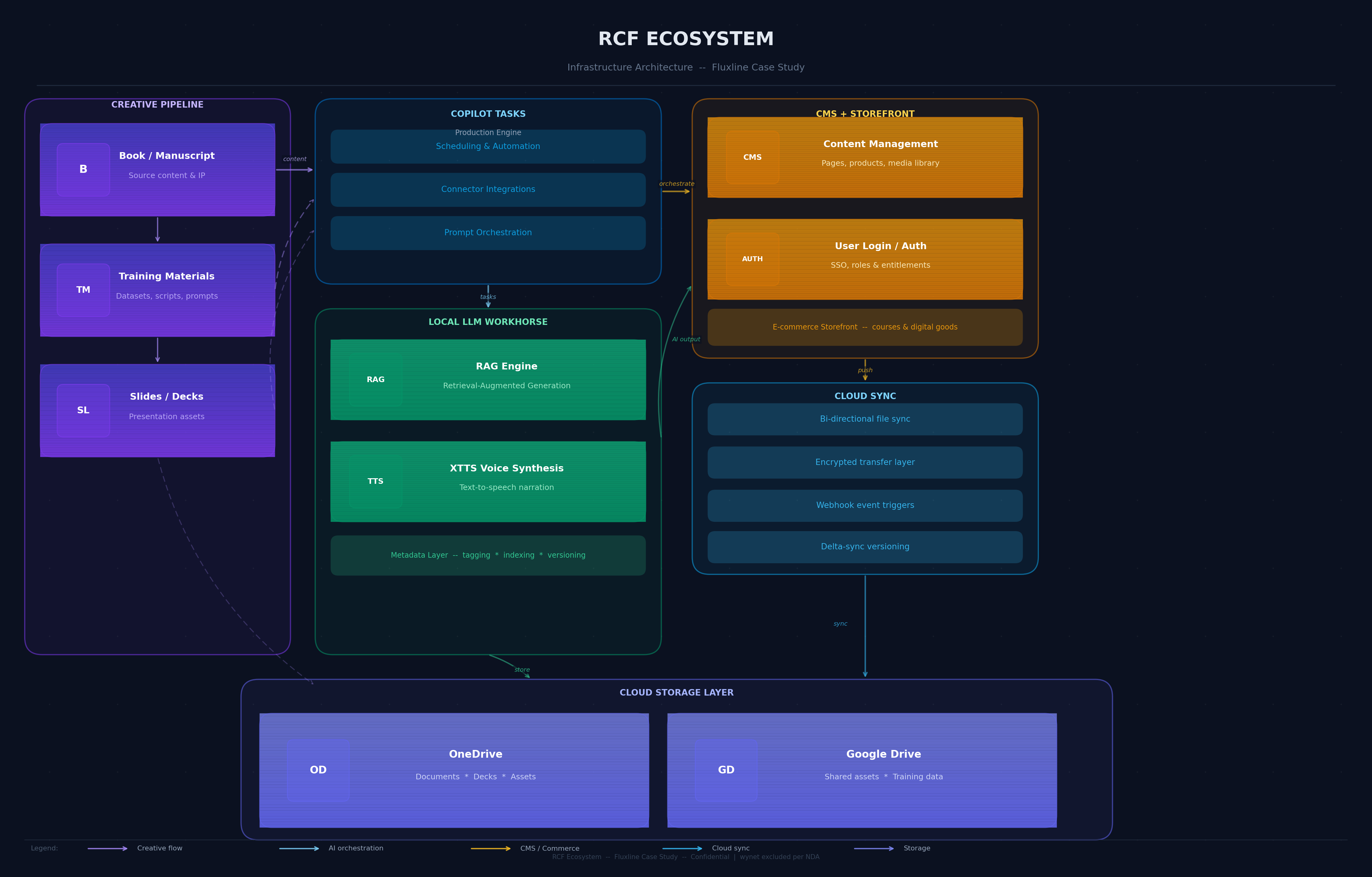
Architecting a Multi-Modal Creative and Technical Ecosystem
How Fluxline evolved from disparate creative practices into a coherent systems-architecture identity — tracing the convergence moment, emotional resonance as infrastructure, dual creative-technical pipelines, Copilot Tasks orchestration, CMS priority shift, and the Resonant Execution Map framework.
Client Testimonial
"I didn't build a brand. I built a nervous system."
Terence Waters
Founder, Fluxline.pro
Key Results
5 stages
Creative pipeline stages
Signal Capture → Conceptual Framing → Multi-Modal Development → AI-Assisted Refinement → Publication & Archival
4 layers
Technical architecture layers
CMS, Deployment Infrastructure, Automation, AI Orchestration
4 layers
Resonant Execution Map layers
Emotional Intent → Creative Decisions → Technical Implementation → Published Output
4 media types
Production scope
Audio, text, visual, structural — unified under one creative logic
Architecting a Multi-Modal Creative and Technical Ecosystem
Author: Terence Waters Date: August 19, 2026 Version: 1.0 — Final Audience: Systems Architects, Creative Technologists, Digital Studio Leaders
The Architecture of Resonance: How Fluxline Became a Living System
"I didn't build a brand. I built a nervous system." — Terence Waters, Founder, Fluxline.pro
Fluxline is not a studio. It is not an agency. It is not a platform, a content channel, or a creative collective. Those categories exist for things that can be described by their outputs. Fluxline is better described by its architecture — the set of relationships, principles, pipelines, and frameworks that give rise to output across every medium I work in. It is a systems-architecture identity: a coherent way of operating that produces music, written work, visual content, technical infrastructure, and strategic frameworks as natural byproducts of a single, unified creative logic.
This case study documents how that coherence came to be. It is not a retrospective on a finished project. It is a map of a living system — one that is still evolving, still expanding, and still surprising me with what it can produce when its layers work in concert. What follows is the story of convergence, of the emotional and technical decisions that shaped Fluxline into what it is today, and of the frameworks I developed along the way to keep the signal intact as it moves from intention to artifact.
Executive Summary
This case study traces the architectural development of Fluxline.pro — a multi-modal creative and technical ecosystem built by Terence Waters. It documents the convergence moment that unified disparate creative practices into a single coherent identity, the philosophy of emotional resonance as structural infrastructure, the dual creative and technical pipelines that power production, the integration of Microsoft Copilot Tasks as an orchestration layer, the priority shift toward CMS infrastructure, and the development of the Resonant Execution Map — a proprietary framework for preserving creative intent across all production layers.
Section 01 — The Convergence Moment
Before Fluxline had a name, it had a signal.
There was a specific afternoon — I remember it with unusual clarity — when I was sitting in the middle of three open projects that had nothing to do with each other. Or so I believed. There was a music production session open in one window, a systems diagram I had been sketching for a content architecture project in another, and a half-written essay on AI integration and authorial voice in a third. I had been living with these threads for months, treating them as separate disciplines that happened to share a practitioner. And then, in a moment I can only describe as a collapse, they stopped being separate.
What I saw — or rather, what I felt before I could articulate it — was that all three activities were expressions of the same underlying operation: the transformation of a signal into a structured artifact. The music was a signal being shaped by arrangement and sound design into an emotional transmission. The content architecture was a signal — a body of meaning — being organized into navigable structure. The essay was a signal being refined through language into a transferable idea. The method was identical. The medium was different. The nervous system was one.
Defining Moment: The convergence was not the discovery of a new idea. It was the recognition that the same idea had been operating across every domain simultaneously — and that naming it, systematizing it, and building infrastructure around it was the next logical act.
In the context of a multi-modal creative practice, convergence is not the same as consolidation. I was not collapsing my work into a single format or forcing it through a single channel. I was recognizing a shared logic that could operate across formats without reducing them. Convergence, as I came to understand it, is the moment when the underlying architecture of a practice becomes visible — when you can see the structure beneath the variety.
The realization that sharpened everything was this: the pipeline was the product. Not the music. Not the essays. Not the visual work. Those were outputs — and valuable ones — but the system that produced them, the way I moved from intention to artifact, the decisions I made at each stage, the constraints I imposed and the freedoms I allowed — that was the real intellectual and creative contribution. Fluxline became the name for that architecture. Not a brand applied to products, but an identity that describes the way I build things, the philosophy under which everything I make operates.
From that point forward, every creative and technical decision I made was filtered through a new question: does this serve the architecture, or does it fragment it? That single reorientation changed everything about how I worked.
Section 02 — Emotional Resonance as Infrastructure
Feeling is not the opposite of function — it is the foundation.
The creative technology world has a persistent and damaging blind spot: the assumption that emotional experience is a product of craft, applied at the end of a technical process. You build the thing, then you make it feel good. You architect the system, then you add the human element. Resonance is treated as a finish coat — something you layer on top once the structural work is done. This assumption is not just aesthetically impoverished. It is architecturally incorrect.
My breakthrough with Fluxline was understanding that emotional resonance is not an output of the creative process. It is an input. It is a structural requirement, as non-negotiable as any technical constraint. When I began designing creative systems with resonance as a first-class design parameter — not a hoped-for outcome but a specified requirement — everything about the quality of the work changed.
Key Insight: Resonance must be specified before the pipeline is built, not evaluated after the output is produced. The question is not "does this feel right?" at the end — it is "what must this transmit?" at the beginning. That distinction determines everything about the architecture that follows.
What does it mean to engineer emotional resonance into a creative pipeline? It means that at the ideation stage, before any content is produced, I define the emotional signature of the piece. Not in vague terms — not "it should feel inspiring" — but with precision. What specific emotional state am I trying to induce? What is the felt experience of encountering this work? What does the audience need to feel in order for this piece to have done its job? These questions are treated with the same rigor I bring to technical specifications. They are documented. They are referenced at every subsequent stage. And they are the final evaluation criterion for whether a piece is ready to publish.
The Fluxline identity is built on the premise that every system I architect — whether it is a music track, a content schema, a technical pipeline, or a strategic framework — is designed to transmit a feeling, not just information. Information without feeling is data. Data that moves no one changes nothing. But a system that is architected to carry emotional weight from its first design decision to its final published form — that is a system that behaves like art, even when it is dressed like infrastructure.
This is not romanticism masquerading as methodology. It is a precise technical philosophy. The emotional signature of a piece is a constraint that governs every decision in the production pipeline. It determines pacing, it determines what gets cut, it determines the texture of the language and the density of the arrangement. When resonance is treated as infrastructure, waste disappears. Every element earns its place by contributing to the transmission, or it is removed. The result is work that is simultaneously more efficient and more powerful — because efficiency and emotional clarity are not in opposition. They are the same thing.
Section 03 — The Creative Pipeline
From signal to artifact — the architecture of creative production.
The Fluxline creative pipeline is a five-stage system that moves from raw signal to published artifact. It is not a linear assembly line — each stage has feedback loops that can return the work upstream — but it has a clear directional logic that keeps production moving forward without losing coherence.
Stage 1 — Signal Capture & Ideation
Every project begins with signal capture: the act of identifying and isolating the core impulse behind a piece. This is not brainstorming. It is closer to excavation. I am looking for the thing that already wants to exist — the emotional or intellectual pressure that is generating creative energy. I use voice memos, rapid written fragments, and audio sketches to capture signals before they are processed into ideas. The goal at this stage is fidelity to the original impulse, not coherence or quality.
Stage 2 — Conceptual Framing
Once a signal is captured, it is framed: given structure, context, and intent. This is where I ask the foundational questions — what format does this signal want to take? What is the emotional signature I am committing to? What constraints will I impose to keep the work focused? Conceptual framing is the stage where intuition becomes architecture. It produces a brief — sometimes a single page, sometimes a table — that governs every downstream decision.
Stage 3 — Multi-Modal Development
Development is where the signal becomes content across multiple media simultaneously. A conceptual frame that begins as a music idea may produce a track, a written reflection, a visual identity element, and a structured insight for the Fluxline content architecture — all from the same core signal. This is multi-modal output by design, not by accident. The same emotional signature, expressed through different sensory channels, creates a coherent body of work that reinforces itself across every touchpoint.
Framework — Multi-Modal Signature Alignment: Each output format (audio, text, visual, structural) is evaluated against the same emotional signature defined in Stage 2. If a piece of music and a piece of writing emerge from the same signal, a listener/reader encountering both should feel the same core experience — expressed differently, but unmistakably related. This is not aesthetic consistency. It is architectural coherence.
Stage 4 — AI-Assisted Refinement
AI tools are embedded throughout the development stage — but with a clearly defined role. AI does not generate the signal, author the frame, or make the final judgment calls. It accelerates the refinement process: expanding language options, surfacing structural alternatives, testing whether the conceptual logic holds across different articulations. The authorial voice remains mine. AI functions as an extremely fast sounding board — one that can produce seventeen variations of a paragraph in the time it takes me to evaluate them, but that cannot tell me which one is true.
Stage 5 — Publication & Archival
Final publication is not the end of the pipeline — it is a handoff into the content architecture. Every published piece is tagged, categorized, and integrated into the Fluxline CMS in a way that makes its relationship to other pieces visible. The pipeline does not end at the artifact. It ends when the artifact is properly situated within the ecosystem — contributing to the larger body of work, searchable, connected, and available for recombination into future projects.
What keeps this pipeline generative rather than mechanical is a set of decision-making rituals I observe at each stage. I do not move from Signal Capture to Conceptual Framing until I can state the emotional signature in a single sentence. I do not publish until I have evaluated the piece against that sentence one final time. These rituals are not bureaucratic checkpoints. They are the moments at which I re-establish contact with the original intention — the acts that prevent the pipeline from grinding the signal into something unrecognizable.
Section 04 — The Technical Pipeline
The skeleton beneath the signal.
The creative pipeline produces the work. The technical pipeline delivers it, stores it, versions it, and makes it available. But in Fluxline's architecture, the distinction between "creative" and "technical" is a convenience of description, not a reality of operation. Every technical decision I have made in building this infrastructure has been governed by the same question I ask of creative decisions: what does this system transmit?
The technical architecture of Fluxline is organized into four layers, each of which maps directly to a creative function:
| Technical Layer | Primary Function | Creative Equivalent |
|---|---|---|
| Content Management System | Schema-driven content storage, taxonomy, and editorial workflow | Memory and meaning architecture — the system that knows what everything is and how it relates |
| Deployment Infrastructure | Build pipelines, hosting, CDN, version control, environment management | Publication and distribution — the act of making work available to its audience |
| Automation Layer | Scheduled tasks, event-driven triggers, workflow orchestration via Copilot Tasks | Rhythm and cadence — the system that keeps the practice moving without requiring constant manual intervention |
| AI Orchestration | API integrations, model routing, prompt management, output evaluation pipelines | Acceleration and amplification — extending the reach of the authorial voice without diluting it |
Key Insight — Systems That Feel: Technical infrastructure carries emotional weight whether you intend it to or not. A CMS with poor taxonomy transmits chaos. A deployment pipeline with inconsistent versioning transmits unreliability. Building technical infrastructure with the same intentionality I bring to creative work is not over-engineering — it is the minimum viable integrity for a serious creative practice.
Version control in the Fluxline system is not merely a technical safeguard — it is a creative record. I version not just code but content: every significant draft, every structural iteration, every conceptual reframe. This creates a full archaeological record of how ideas develop, which is itself a creative resource. When I return to a piece six months later and need to understand why I made certain decisions, the version history tells that story. The technical system preserves the creative logic, not just the outputs.
Asset movement through the system follows a defined logic: raw assets enter through a staging environment where they are validated against schema and tagged before they are promoted to production. This is not bureaucracy for its own sake. It is the technical equivalent of my decision-making rituals in the creative pipeline — a moment of deliberate evaluation before a piece moves forward. Nothing reaches the public-facing content layer without passing through a structured integration process. The system enforces the same standards of intentionality that I try to maintain manually.
The philosophy I have come to call "systems that feel" is the governing principle of the entire technical architecture. It means that the experience of encountering the Fluxline ecosystem — navigating the site, moving through content, encountering the structure of information — should itself carry an emotional quality. Coherence. Clarity. Confidence. These are not design aesthetics applied to the interface. They are structural properties built into the technical architecture at every level.
Section 05 — Copilot Tasks as Production Engine
AI orchestration is not a productivity hack — it is a compositional act.
The way most practitioners use AI is as a tool: you pick it up when you need it, put it down when you are done, and evaluate the output as a discrete deliverable. This is a perfectly valid way to extract value from AI capabilities. It is not, however, the way Fluxline operates. The integration of Microsoft Copilot Tasks into the Fluxline production engine represents a qualitatively different relationship with AI — one in which the AI is not a tool but a production layer, with defined roles, consistent responsibilities, and scheduled participation in the creative process.
The distinction I draw here is between automation and orchestration. Automation is the replacement of manual action with a scripted process. It removes the human from the loop. Orchestration is the coordination of multiple agents — human and artificial — toward a shared compositional goal. It does not remove the human. It restructures the human's role so that their attention and creative energy are directed toward the decisions that require judgment, while everything that does not require judgment is handled by the orchestration layer.
Framework — Automation vs. Orchestration: Automation asks: "What can I remove the human from?" Orchestration asks: "What configuration of human and AI attention produces the best possible outcome?" Fluxline operates entirely in the orchestration register. The human is always in the loop — but the loop has been redesigned.
In practical terms, Copilot Tasks handles the following workflows within the Fluxline production engine:
- Scheduled Content Tasks: Daily and weekly scheduled tasks that prompt content review cycles, surface backlogged drafts, generate editorial briefs based on current thematic priorities, and queue pieces for publication according to the content calendar.
- Automated Research Pipelines: Scheduled research tasks that compile relevant developments in specified domains — creative technology, AI orchestration, music production — and deliver synthesized briefings at defined intervals. These briefings feed directly into the ideation stage of the creative pipeline.
- Document Generation: Copilot Tasks generates structured documents — project briefs, framework documentation, case study drafts, technical specifications — from a defined prompt architecture, dramatically compressing the time between conceptual framing and initial draft.
- Calendar and Communication Orchestration: Scheduling, reminders, follow-up drafting, and communication management are coordinated through Copilot Tasks, freeing cognitive bandwidth for creative and strategic work.
The result is a production capability that scales without the typical costs of scaling: without hiring, without delegation risk, without the dilution of vision that comes from distributing creative decisions across multiple people. Copilot Tasks does not make decisions. It creates the conditions under which I can make better decisions more consistently, at a higher volume, without the cognitive overhead that would otherwise make that volume impossible to sustain.
What makes this integration compositional rather than merely operational is the intentionality with which the tasks are designed. A Copilot Task in the Fluxline system is not a shortcut. It is a designed instrument — a precisely specified process that has been thought through with the same rigor as any creative framework. The prompts are crafted. The schedules are considered. The outputs are evaluated. The system is tuned. This is orchestration in the musical sense: every instrument has a part, the parts are written to serve the larger composition, and the conductor — which is to say, me — decides when each instrument plays.
Section 06 — The CMS Infrastructure Priority Shift
The content management system became the connective tissue of the entire operation.
There was a period in the development of Fluxline when I was producing significant creative output but experiencing a growing sense of architectural debt. Content existed in multiple places. Published pieces were not connected to each other in any meaningful way. The taxonomy was implicit — I knew how things related, but the system did not. Searching for a specific piece of writing from six months ago was an act of memory, not retrieval. The creative work was strong. The infrastructure around it was, by any honest assessment, a mess.
The decision to make CMS infrastructure the architectural priority for Fluxline.pro was not a technical decision. It was a philosophical one. It was the recognition that a body of creative work without coherent infrastructure is not a practice — it is an archive in the process of becoming inaccessible. For Fluxline to function as a living system, the system needed to know what it contained, how its contents related to each other, and how to surface the right content at the right moment — both for my own use as a practitioner and for anyone encountering the work from the outside.
Defining Moment — The Architecture Becomes Visible: The shift happened when I stopped thinking of the CMS as a publishing tool and started thinking of it as a knowledge architecture. The question stopped being "where do I put this piece?" and became "how does this piece know what it is, what it belongs to, and what it means within the larger body of work?"
The CMS I selected for Fluxline.pro operates on a headless architecture principle: content is stored and managed independently of its presentation layer. This means the same content can be surfaced in multiple contexts — on the website, in a document, in a research briefing, in a Copilot Task output — without being reformatted or re-entered. The content exists once, in a canonical form, and the system knows how to render it appropriately for each context. This is a direct technical expression of the Fluxline philosophy: a single signal, expressed through multiple channels, maintaining its integrity across every transformation.
Content modeling was the most intellectually demanding part of the CMS build. I had to answer a set of questions that are simultaneously technical and philosophical: What is a "piece" in the Fluxline ecosystem? What fields define it? What taxonomies categorize it? What relationships connect it to other pieces? How does the schema encode not just the content but the meaning of the content — the emotional signature, the thematic thread, the production stage it exists at?
The taxonomy I designed reflects the Resonant Execution Map (described in the following section): content is tagged not just by format and topic but by its emotional signature, its production stage, and its relationship to specific Fluxline frameworks. This means the CMS is not just a filing system — it is a knowledge architecture that makes the relationships between pieces explicit and navigable. The connective tissue of the entire operation is no longer implicit in my memory. It is structural. It is in the system.
| CMS Design Principle | Technical Implementation | Creative Function |
|---|---|---|
| Headless architecture | Content stored via API, decoupled from front-end rendering | Signal stored once, expressed in any format |
| Schema-driven content modeling | Structured content types with defined fields and validation | Every piece knows what it is and where it belongs |
| Resonance taxonomy | Custom tags: emotional signature, framework association, production stage | The system encodes meaning, not just metadata |
| Editorial workflow integration | Draft → Review → Approved → Published states with Copilot Task triggers | The pipeline's decision-making rituals are embedded in the infrastructure |
| Relational content linking | Explicit relationships between content items across types and formats | The body of work is navigable as a connected whole, not a collection of isolated pieces |
Section 07 — The Resonant Execution Map
A framework for turning vision into output without losing the signal.
Every multi-stage production process faces the same fundamental risk: signal loss. The original vision — the thing you were trying to make, the feeling you were trying to transmit — degrades as it moves through layers of execution. By the time a piece is published, it may bear only a superficial resemblance to the original intention. This is not a failure of craft. It is a structural problem. Without a system that explicitly preserves and evaluates the original signal at every stage, degradation is inevitable.
The Resonant Execution Map is the framework I developed to solve this problem. It is a proprietary planning and quality-control instrument that governs the entire Fluxline production process — creative and technical — from initial intention to published output. It is not a project management template. It is a signal-preservation architecture.
Framework — The Resonant Execution Map (REM): The REM maps four sequential layers: Emotional Intent → Creative Decisions → Technical Implementation → Published Output. At each layer, the map includes both forward-facing specifications (what this layer must produce) and backward-facing evaluations (how to confirm that the signal from the previous layer has been preserved). The map is filled in before production begins and consulted throughout.
Layer 1 — Emotional Intent
The first layer of the REM documents the emotional signature of the piece: the specific felt experience I am committing to transmit. This is written in precise, phenomenological language — not "this should feel powerful" but "this should feel like the moment just before a decision becomes irreversible — clarifying, slightly vertiginous, and ultimately grounding." This precision is not about pretension. It is about having a standard that is specific enough to evaluate against. You cannot evaluate a piece against "powerful." You can evaluate it against a precisely described experiential state.
Layer 2 — Creative Decisions
The second layer maps the creative decisions that serve the emotional intent: structural choices, tonal choices, format decisions, constraint selections, and the specific techniques that will be used to produce the intended experience. This layer is the translation from feeling to form. It answers the question: given this emotional specification, what creative decisions follow necessarily?
Layer 3 — Technical Implementation
The third layer maps the technical decisions that serve the creative decisions: which tools, which pipelines, which formats, which infrastructure components are required to execute the creative vision without compromise. This layer makes explicit the relationship between creative requirement and technical specification — preventing the common failure mode in which technical constraints silently override creative intentions without anyone acknowledging the trade-off.
Layer 4 — Published Output
The fourth layer is the evaluation layer: a structured review of the published piece against the emotional intent specified in Layer 1. Did the piece transmit what it set out to transmit? If not, where in the production chain did the signal degrade? The answers to these questions feed back into the framework, refining both the map itself and the production processes that it governs.
In practice, I have applied the REM across a wide range of Fluxline projects. When producing a music track, the map specifies the emotional arc of the piece before a single sound is placed — and the final mix is evaluated against that arc, not against aesthetic preferences or technical benchmarks in isolation. When developing a piece of written content, the map documents the intended reading experience before a word is written — and the editing process is governed by asking, at each cut and revision, whether the change preserves or degrades that experience.
Key Insight — Preventing Signal Loss: The most common point of signal loss in creative production is the transition between Layer 2 and Layer 3 — where creative decisions meet technical implementation. The REM makes this transition explicit and deliberate, forcing a conversation between creative intent and technical reality before the build begins rather than after the output is delivered.
The Resonant Execution Map has become central to Fluxline's systems-architecture identity for a simple reason: it is the instrument that makes the identity coherent across projects. Without it, the quality of signal preservation is a function of how alert and focused I am on any given day — which is to say, it is inconsistent. With it, the preservation of the original signal is a structural property of the production process, not a personal quality I have to summon. The map does not guarantee great work. It guarantees that the work produced is the work that was intended — which is the prerequisite for great work becoming possible consistently.
Section 08 — Relevance to Fluxline's Systems-Architecture Identity
Fluxline is the proof of concept for a new kind of creative infrastructure.
Standing back from the architectural decisions documented in this case study, a pattern emerges that is larger than any of its individual components. The creative pipeline, the technical architecture, the Copilot Tasks integration, the CMS infrastructure, the Resonant Execution Map — these are not separate initiatives that happened to occur in the same practice. They are expressions of a single underlying philosophy, applied at different scales and in different registers.
That philosophy, stated plainly, is this: coherence is not a quality that emerges naturally from creative work over time. It is a structural property that must be designed into the systems that produce the work. The experience of Fluxline as a coherent identity — the sense that its music, its writing, its visual work, its technical infrastructure, and its strategic frameworks all emanate from the same source — is not an accident of personality. It is a consequence of architecture.
This is the contribution that Fluxline makes to the conversation about creative practice in the age of AI and distributed production: a demonstration that it is possible to build a creative identity that is simultaneously personal and systematic, simultaneously artistically rigorous and technically sophisticated, simultaneously individual in its voice and scalable in its production. The two poles of that equation are not in tension if the architecture is correct. They are in resonance.
For systems architects, creative technologists, and digital studio leaders looking to build their own coherent creative-technical ecosystems, the Fluxline model offers several transferable principles:
- Convergence before consolidation. Recognize the shared logic beneath your disparate practices before you try to unify them structurally. The architecture should reflect the convergence, not create it.
- Resonance as specification. Define the emotional signature of what you are building before you build it. Treat it as a technical constraint, not an aspiration.
- Pipeline before product. Invest in the system that produces your work with the same seriousness you invest in the work itself. The pipeline is the real intellectual contribution.
- Orchestration over automation. Design AI integration that restructures your role rather than removes it. The goal is better decisions at higher volume, not fewer decisions.
- Infrastructure as intention. Build your technical systems with the same intentionality you bring to your creative work. Every system transmits something. Make sure it is transmitting what you intend.
These principles are not a formula. They are a set of commitments — a way of orienting toward the work that, once adopted, changes the character of every decision that follows. That is what Fluxline represents: not a finished product, not a completed project, but a commitment to building with intention at every layer, from the first captured signal to the last published artifact.
The system is alive. It is still being built.